
PhD Holders per Capita vs GDP per Capita: Global Correlation and Trends
Key Findings and Correlation Overview
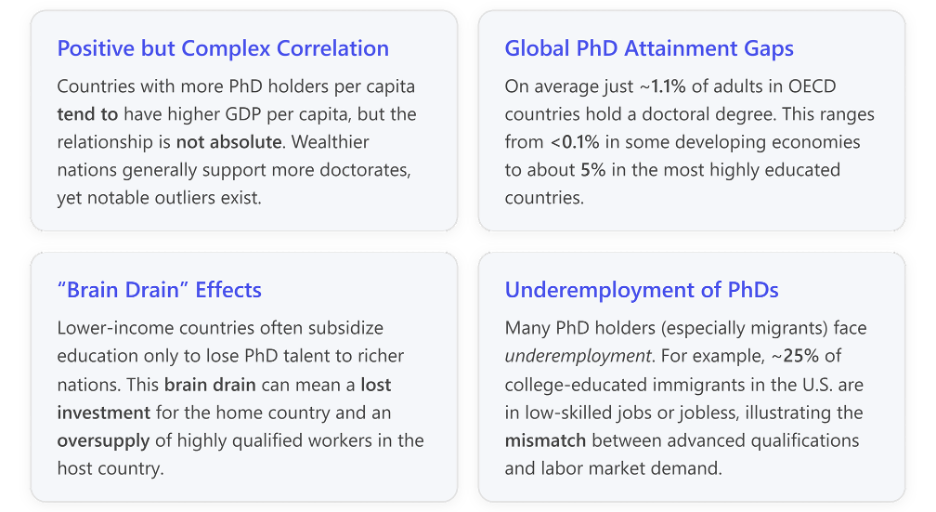
Worldwide data indicate a positive correlation between the density of PhD holders in a country’s population and its economic prosperity (GDP per capita). In broad terms, nations that invest heavily in higher education and produce more doctoral graduates tend to be economically better off. For instance, Slovenia and Switzerland rank among the highest in PhD holder share (roughly 5% and 3% of their populations, respectively) and also enjoy relatively high income levels. Conversely, in developing countries like Indonesia or Mexico, only around 0.1% of the population has a PhD, and these nations have far lower GDP per capita. This suggests a general trend: higher PhD attainment often accompanies higher GDP per person. [timesnownews.com]
However, the correlation is far from perfect. Our analysis using latest available figures finds the relationship is moderately positive (for a sample of countries, Pearson’s r is on the order of +0.3 to +0.4). In other words, wealthy countries are more likely to have a high concentration of PhDs, but there are significant exceptions. A country’s economic output and its stock of doctorate holders do not rise in lockstep, due to various social and economic factors discussed below.
To illustrate, the OECD reports that on average 1.1% of 25–64 year-olds hold a doctoral degree across its member countries. Within that group, there is a wide gulf: at the low end, Indonesia and Mexico have about 0.1% or less of adults with doctorates, whereas at the high end Slovenia and Switzerland exceed 3%. (In fact, Slovenia reaches around 5% when considering its whole population.) Many advanced economies fall in between, with about 1–2% of their population holding PhDs. The United States, for example, has roughly 1.2% of its total population with a PhD (about 2% if counting only working-age adults), while the United Kingdom is around 2%. These figures underscore the considerable cross-country variation in educational attainment at the doctoral level. [timesnownews.com] [master-academia.com]
PhD Density and GDP per Capita: Data Comparison by Country
To better see the relationship, the table below compares a selection of countries on two metrics: (1) the percentage of the population that holds a PhD (doctoral degree), and (2) GDP per capita in current US dollars (a measure of average economic output per person). The countries chosen include those with some of the highest PhD-holder rates in the world and those with very low rates, spanning advanced and developing economies:
Countries with Highest PhD Holders per Capita:
Country
Share of Population with PhD
GDP per Capita (USD)
Slovenia
$36,500 [worldpopul…review.com]
Switzerland
$111,700 [worldpopul…review.com]
Luxembourg
$141,100 [worldpopul…review.com]
United Kingdom
$54,300 [worldpopul…review.com]
Countries with Low PhD Holders per Capita:
Country
Share of Population with PhD
GDP per Capita (USD)
Mexico
~0.1% [timesnownews.com]
$10,300 (approx.) [americanim…ouncil.org]*
Indonesia
~0.1% [timesnownews.com]
$5,200 [worldpopul…review.com]
India
<0.5% (est.) [timesnownews.com] †
$2,900 [worldpopul…review.com]
South Africa
<1% (est.) [worldpopul…review.com] †
$6,500 [worldpopul…review.com]
*Mexico’s GDP per capita was roughly $10k as of mid-2020s. †Precise PhD rates for India and South Africa are not reported in the cited sources; estimates noted based on context (India produces ~24k PhDs annually, indicating a very low percentage given its 1.4B population; South Africa’s PhD share is under 1% as it wasn’t among countries at the 1% threshold). [americanim…ouncil.org] [timesnownews.com] [worldpopul…review.com]
Looking at the high-PhD group, we see a mix of wealthy and moderately wealthy nations. Rich, innovation-driven economies like Switzerland and Luxembourg pair very high GDP per capita (above $100k) with a high prevalence of PhDs (around 2–3%). Interestingly, Slovenia stands out: despite a more modest GDP per person (~$36k, roughly one-third of Switzerland’s), Slovenia boasts the world’s highest doctoral attainment (~5% of people). This suggests that factors beyond immediate wealth—such as education-focused policies or cultural values—can elevate PhD attainment. The UK also demonstrates a strong research orientation with ~2% of its population holding PhDs, in line with its status as a developed economy (GDP per capita ~$54k). [timesnownews.com] [master-academia.com]
In the low-PhD group, large emerging economies like Mexico and Indonesia have extremely small shares of PhD holders (~0.1%) alongside mid-to-low income levels. India, despite being among the top producers of PhD graduates by absolute numbers (over 24,000 new doctorates per year), has a tiny fraction of its populace with a PhD given its huge population (hence an estimated well below 1%). And in South Africa, although exact figures are not in the above sources, the percentage with doctorates is also very low (likely on the order of a few tenths of a percent), consistent with its moderate income level. These cases exemplify the challenge for developing countries to significantly increase advanced education attainment amid limited resources and opportunities. [timesnownews.com]
In summary, higher education (PhD) levels and economic prosperity do correlate positively on a global scale, reinforcing the idea that an educated workforce contributes to wealth. Yet, the correlation is not deterministic – other factors (like natural resources, industrial structure, or historical investments) also drive GDP, and the mere presence of PhDs doesn’t guarantee immediate economic payoff. The following sections explore why these discrepancies occur, including the roles of migration and labor market dynamics.
The Two-Edged Sword: Brain Drain and Talent Migration
Higher education is often pursued with the expectation of better opportunities, but these opportunities may lie abroad. Many developing countries face a “brain drain”: a significant outflow of highly educated individuals (including PhD holders) who migrate to advanced economies in search of better jobs, research facilities, and living conditions. This phenomenon creates a paradox. On one hand, it benefits the receiving (host) countries – they gain skilled talent without bearing the full cost of their education. On the other hand, it can disadvantage the source countries – they effectively subsidized the training of experts who then leave, resulting in a “wasted” investment and a shortage of skilled professionals at home. [ebsco.com]
Impact on Origin Countries: For nations that struggle economically, losing top graduates can undercut their growth potential. They not only forgo the direct contributions those PhDs might have made in science, industry, or education, but also suffer financial losses. For example, around the early 2000s it was estimated that approximately 20% of skilled South Africans emigrated, costing South Africa about $250 million annually in lost human capital. Similarly, the United Nations in 2001 estimated that India was losing around $2 billion per year due to brain drain – a huge loss given India’s development need. In effect, countries like India produce tens of thousands of highly trained graduates (India is among the top 4 producers of PhDs globally), but a significant number seek careers overseas. This drains the local economy of their expertise, potentially slowing innovation and public service delivery in the home country. [ebsco.com] [timesnownews.com]
Impact on Destination Countries: Advanced economies benefit from an influx of educated migrants – it fills skill gaps and can boost innovation and productivity in those countries. For instance, international doctoral students make up more than half of all PhD candidates in places like Switzerland and Luxembourg, meaning these countries’ research sectors heavily rely on foreign talent. In the long run, many of those graduates stay and join the host country’s workforce. The United States in particular has attracted large numbers of foreign PhDs for decades; fewer than half of foreign doctoral students in the US end up returning home after graduation. This “brain gain” for the U.S. has contributed to its scientific and tech leadership (as evidenced by significant proportions of patents and innovations involving foreign-born inventors). [timesnownews.com] [ebsco.com]
However, an oversupply of talent in destination markets can create its own problems. When many highly educated individuals compete for limited high-level positions, not all can find jobs commensurate with their credentials. This leads to the issue of “brain waste”: talented people working in roles far below their qualification level. A classic image is the PhD taxi driver – emblematic of a doctorate holder unable to find suitable professional employment in their field. Research confirms this is more than just an anecdote. In the United States, roughly one in four college-educated immigrants end up either in low-skilled jobs or unemployed. That translates to nearly 2 million highly skilled immigrants in the U.S. who are not fully utilizing their education. This underemployment is costly: it was estimated to result in about $39 billion in lost wages annually (and correspondingly lower tax contributions) because these individuals cannot work at their skill level. [americanim…ouncil.org]
In short, rich countries may experience a glut of advanced degree holders relative to high-end jobs available. Many foreign-trained PhDs (and even domestic ones in fields with fewer openings) may only find work in unrelated or lower-paying sectors. The mismatch between education and employment means that simply having more PhDs doesn’t directly increase a nation’s GDP – those PhDs must be effectively employed in productive roles to drive economic gains. This nuance partly explains why the correlation we observed is moderate: some countries have built up a large educated class without a proportional increase in high-value economic output, because a number of those individuals either left or are not leveraged fully in the economy.
Higher Education and Economic Outcomes: Discussion and Notable Trends
So, does a higher density of PhD holders cause greater economic prosperity, or does prosperity enable more citizens to pursue PhDs? The relationship works in both directions to an extent:
· Economic Prosperity Enables Education: Wealthier countries can afford to invest heavily in education, research, and development. They often have more universities, funding for graduate programs, and incentives (scholarships, research grants) that encourage people to attain doctorates. They also attract talent globally. For example, countries like Switzerland have strong research funding and attract PhD candidates from abroad, sustaining a high PhD-per-capita ratio. High GDP per capita also usually means higher salaries for PhD-level jobs (in academia or industry), making it worthwhile for individuals to pursue lengthy doctoral studies. This is why almost all countries with ≥1% of their population holding PhDs are high-income nations – predominantly in Europe plus the U.S., Canada, Australia, etc. [worldpopul…review.com], [worldpopul…review.com]
· Education Contributes to Economic Growth: Over the long run, having more highly educated people can boost a country’s innovation, productivity, and capacity for technological advancement. PhD holders often drive research and development (many are scientists, engineers, or experts whose work can lead to new industries or efficiencies). A greater concentration of PhDs can indicate a strong “knowledge economy,” which is associated with higher value-added output. The World Bank and UNESCO data show that high-income countries also have far more researchers per capita (often several thousand R\&D researchers per million people) than low-income countries, correlating with greater patent output and high-tech economic sectors. In theory, if a developing country can retain and utilize more of its highly educated citizens, it could accelerate economic development.
However, the notable anomalies and edge cases highlight that context matters. Slovenia is an interesting case: despite not being among the very richest countries, it has prioritised advanced education to the point of outpacing many richer countries in PhD attainment. This might be due to strong educational infrastructure and cultural emphasis on advanced degrees. Its economy (part of the EU) has benefited from a skilled workforce, but Slovenia’s example also shows that having the highest PhD rate in the world doesn’t automatically make you the richest. Luxembourg, by contrast, is one of the richest countries (thanks to finance and banking) yet “only” about 2% of its populace has a doctorate – a high figure globally, but lower than expected given its wealth. Luxembourg relies heavily on skilled foreign labor and has a small population, so its per-capita GDP is high from specialized industries rather than broad-based doctoral education. In fact, as noted earlier, more than half of Luxembourg’s doctoral students are international, suggesting its domestic PhD production is limited despite wealth (many natives may choose lucrative jobs in industry or finance instead of pursuing PhDs). [timesnownews.com] [worldpopul…review.com]
Another trend is the saturation of academia in advanced economies. In many countries, the number of new PhD graduates now vastly exceeds the number of academic job openings (professorships, research positions) available. For example, China and India are churning out PhDs at an unprecedented rate (China had over 600,000 PhD candidates enrolled in 2023), and across the OECD the annual number of doctorate recipients nearly doubled from 1998 to 2017. This “PhD boom” means many PhD holders must find careers outside academia. In the UK, a survey found over two-thirds of recent PhD graduates work outside of academia – often in industry, government, or alternate careers. This can be positive if their skills are employed in high-tech industries or leadership roles, contributing to economic output. But it can also mean PhDs taking jobs unrelated to research or below their expertise. A South African survey found 18% of PhD graduates had trouble finding jobs related to their expertise, and some felt “overqualified and undervalued” in the jobs they did take. Instances like these emphasize that simply increasing the number of PhDs does not guarantee economic improvement unless the economy can absorb and make use of their high-level skills. [nature.com], [nature.com] [nature.com]
Brain drain exacerbates this mismatch for developing nations. When a significant share of the brightest minds leave, the home country doesn’t reap the full benefits of its educational investments. Some economists argue this can even hurt GDP growth in those countries. The flip side is a concept known as “brain circulation” – if those individuals eventually return home with enhanced skills or if diaspora networks stimulate trade and investment, origin countries can gain in the long run. There’s evidence of such positive effects (e.g. remittances, knowledge transfer) but it varies by country. A few nations have implemented policies to counteract brain drain, such as improving local research conditions or offering incentives for expatriates to return. For example, China and India have seen some reverse migration in recent years as their economies grow, a “reverse brain drain” where skilled workers move back home to take advantage of new opportunities. This can help spread the gains of high education more evenly globally. [ebsco.com], [ebsco.com] [ebsco.com]
Conclusion: Education, Migration, and Prosperity Intertwined
In conclusion, countries with a higher concentration of PhD-educated people generally enjoy higher levels of GDP per capita, reflecting the strong link between advanced human capital and economic development. Knowledge-driven economies (like much of Western Europe, North America, and Northeast Asia) both produce and attract more doctorate holders, creating a virtuous cycle of innovation and growth. Empirical data from organizations like the OECD and World Bank back this positive correlation. [timesnownews.com]
At the same time, the relationship is complex and bidirectional. High GDP enables more education, while education (if retained and applied) fosters higher GDP. There are striking exceptions where the alignment isn’t direct: some small or mid-income countries manage to punch above their weight in PhD production (e.g. Slovenia’s exceptional attainment), whereas some wealthy nations derive income from natural resources or finance rather than domestic education (leading to cases like oil-rich states or Luxembourg with sky-high GDP but not correspondingly high local PhD rates). [timesnownews.com]
Crucially, migration patterns and labor market structures moderate the benefits of growing a highly educated population. The “two-edged sword” of brain drain means that for many developing countries, encouraging higher education alone won’t improve the economy unless those educated workers remain engaged in the domestic market. When PhD holders emigrate in large numbers – as has happened in parts of Africa, South Asia, and Eastern Europe – the origin country may see little return on its educational investments. For the destination countries, an influx of PhDs can boost the economy, but if the supply exceeds demand in high-skill jobs, it leads to underemployment of talent. That represents unrealized potential both for the individual and the economy at large. [ebsco.com] [americanim…ouncil.org]
Overall assessment: Higher education (especially at the doctoral level) is an engine of growth for societies, but its impact on economic prosperity depends on context. In environments where PhD skills are harnessed – through R\&D, innovation, and advanced industries – we observe a strong positive payoff (as seen in most advanced economies). Where there is a mismatch – due to brain drain or lack of advanced industries to employ PhDs – an increase in PhD holders might not immediately translate to higher GDP, and could even signify a brain export. Therefore, while there is a correlation between PhD density and GDP per capita, it comes with caveats. Policymakers in developing regions are increasingly aware of this, looking for ways to retain talent and create knowledge-based job opportunities at home, so that the investment in education yields domestic economic returns. Similarly, advanced countries are working to better integrate highly educated immigrants and broaden career pathways for PhD graduates in all sectors, to avoid wasting valuable human capital. [nature.com], [nature.com]
In summary, PhD attainment and economic prosperity go hand-in-hand in many cases, but not automatically. The correlation is positive but not fate: it reflects underlying factors like innovation capacity, labor market dynamics, and cross-border talent flows. High numbers of PhD holders can be a boon to an economy – driving innovation and growth – if those minds are effectively utilized and retained. The key is striking the right balance between developing advanced skills and ensuring those skills can be applied to boost the local and global economy, for the benefit of both individuals and societies. [ebsco.com], [americanim…ouncil.org]
