
Bridging Policy and Practice in RTOs The Hidden Compliance Gap and Its Consequences
Registered Training Organisations (RTOs) in Australia operate under strict standards (notably the Standards for RTOs and VET Quality Framework) designed to ensure high-quality vocational education. These standards, regulated by the Australian Skills Quality Authority (ASQA), require RTOs to maintain robust policies for everything from training delivery and assessment to student support, governance, and continuous improvement. Yet a recurring challenge in the VET sector is the gap between policy as an artefact (the written, documented policies) and policy as lived practice (what actually happens day-to-day in training and administration). In other words, it’s one thing to have policies on paper; it’s another way to fully implement them in the real world.
This report examines the negative costs and effects of that policy–practice gap on Australian RTOs, drawing on recent audit findings, regulatory reports, and sector commentary. As one VET compliance expert aptly noted, “It is not enough to have a policy on paper—its true impact lies in implementation”. The new 2025 Standards for RTOs echo this principle: “It is no longer enough to have a policy; you must demonstrate how you monitor that policy and use data to improve.” This shift from “tick-box” compliance toward continuous self-assurance means RTOs are now judged on how well they translate written policies into consistent practice. Failure to do so can carry significant consequences, including compliance breaches, audit failures, increased staff workload, detrimental impacts on learners, and damage to organisational reputation.
The “Paper vs Practice” Gap in RTO Compliance
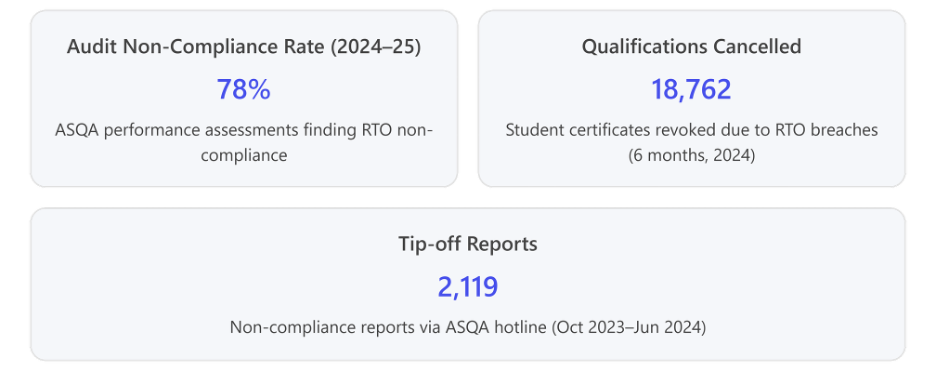
Having documented policies and procedures is a baseline requirement for any RTO, but many providers struggle to ensure those rules are reflected in everyday practices. ASQA auditors consistently find misalignments between “documented compliance” and operational execution. In fact, 60% of ASQA’s 379 performance audits in 2023–24 found at least one non-compliance, and in 2024–25 the rate of audits identifying non-compliance issues jumped to 78% of RTOs audited (221 out of 284). These figures indicate that most RTOs have some gap between what their policies promise and what actually occurs in training, assessment, or administration. As an ASQA audit report puts it, *“an RTO compliance audit tests real operations, not intent,” focusing on whether “documented compliance matches operational execution”. In practice, this means that an RTO can have all the required policies filed away and still face compliance action if staff and trainers are not following those policies in their day-to-day work. [peoplepart…ersbpo.com] [peoplepart…ersbpo.com]
Common symptoms of the policy–practice gap have been well documented. An internal analysis of audit outcomes in 2024 highlighted several “collapse points” where things fall apart: policies get updated but not fully embedded, so staff do something different than the document says; assessment and validation records are scattered, undermining consistency; key reporting tasks are delayed because roles and responsibilities for compliance are unclear; and evidence is untraceable due to ad-hoc naming conventions or storage practices. In essence, there is often a “drift between ‘on paper’ compliance and how work really happens” in RTO operations. Under the pressure of an audit, these gaps become painfully clear: “Evidence that is ‘somewhere’ becomes evidence that cannot be produced” on demand, and if records tell a different story from staff explanations, auditors will uncover a problem. [peoplepart…ersbpo.com] [peoplepart…ersbpo.com]
Compliance Risks and Audit Failures
The most immediate cost of a policy–practice gap is heightened compliance risk. RTOs that fail to implement their own policies run afoul of the Standards for RTOs and regulatory expectations, opening themselves to non-compliances during audits. ASQA’s audit findings in recent years show that non-compliance is widespread, suggesting that having written policies “on file” is no guarantee of passing an audit. Auditors are trained to follow the evidence trail – they will compare the RTO’s documented procedures to the actual training delivery, student assessments, and support services that have taken place. When those evidence trails break or diverge from what the policy says should happen, the result is a non-compliance finding. According to ASQA data, the outcome is clear: “Providers are not necessarily failing for lack of policies, but operational breakdowns become obvious once auditors follow the evidence trails.” [peoplepart…ersbpo.com]
The Standards for RTOs (2015 & 2025) both require not just policy documents, but effective implementation and continuous improvement. For example, Standard 2 of the 2015 Standards called for the RTO’s operations to be quality assured, and Standard 8 required compliance with legislation, both implying that policies must be enacted in practice. The new 2025 Standards go even further, explicitly emphasizing outcome-based compliance and self-assurance (providers must actively monitor and self-evaluate their performance). ASQA’s updated approach means an RTO could have comprehensive policies and still be deemed non-compliant if they cannot demonstrate those policies are working in reality. An RTO might, for instance, have a detailed assessment policy, but if an audit finds that teachers are using outdated assessment tools or not following the stated moderation process, the RTO will be judged non-compliant with the standards for assessment (e.g. Standard 1 in both 2015 and 2025 versions, which require valid, consistent, and fair assessment practices). [rtoresourc…led.com.au], [rtoresourc…led.com.au] [rtoresourc…led.com.au], [peoplepart…ersbpo.com]
The outcomes of an audit failure are serious. Initially, ASQA provides RTOs an opportunity to rectify non-compliances, but significant gaps between policy and practice can lead to sanctions. These range from conditions on registration and additional monitoring, to suspension or cancellation of the RTO’s registration in extreme cases. A stark illustration of the fallout came in late 2024, when ASQA reported the mass cancellation of 18,762 qualifications and statements of attainment that had been issued by previously deregistered RTOs. In other words, thousands of students’ credentials were voided “to protect the public” because those RTOs had failed to actually follow the standards they claimed to uphold. This not only represents a huge compliance failure but also a direct cost to the RTO (which may be liable for refunds and reputational damage) and to students (who lost their qualifications). [peoplepart…ersbpo.com]
ASQA’s regulatory enforcement aims to safeguard learners and maintain confidence in the VET sector’s integrity. The regulator’s posture has been increasingly proactive: for example, performance audits can occur with short notice and demand urgent evidence. An RTO heavily reliant on ad hoc efforts will find it difficult to pull together “clean” evidence of compliance within days or even hours. One RTO consulting firm observed that if compliance evidence and processes “live in someone’s head rather than in documented workflows,” or if “audit evidence trails stop halfway because the ‘owner’ has left,” the RTO’s audit readiness becomes “luck-based”. In fact, staff turnover or absent key personnel can instantly turn paper compliance into non-compliance if knowledge isn’t institutionalized. It is worth noting that ASQA’s VET compliance tip-off line received over 2,100 reports in just nine months of 2023–24 from stakeholders raising alarms about RTO practices (with common issues cited including poor record-keeping and even falsification of records). This underscores the prevalence of concerns about RTOs not following their own policies or required standards. [peoplepart…ersbpo.com] [peoplepart…ersbpo.com]
Staff Workload, Burnout, and Governance Gaps
Maintaining compliance on paper without integrated practices imposes a heavy burden on staff. In many RTOs with policy–practice gaps, compliance duties become reactive “fire-fighting” tasks undertaken on top of normal teaching or administration responsibilities. This often translates to compliance being treated as a “side task, done after delivery work,” which means critical activities like updating records, conducting internal audits, or reviewing assessment tools are postponed or rushed. The result is staff overwork and burnout, as well as missed or poor-quality compliance actions (for example, internal audits may be “deferred because nobody has time or authority” to do them, and validation of assessment tools might be completed late or not at all). Recent studies of Australian workplaces highlight that the education and training sector is particularly prone to high workloads and stress hazards, conditions which can directly affect an RTO’s compliance. When people are exhausted or unsure of their roles, “later becomes the default, and later is where validation schedules quietly disappear”. [peoplepart…ersbpo.com]
A lack of role clarity and ownership of compliance tasks is another costly effect of the policy–practice divide. If everyone assumes “someone” else is responsible for a procedure, often no one actually performs it properly. A typical example is when training and assessment strategies (TAS) are updated on paper, but staff delivering the course aren’t fully trained on the changes – leading to instructors teaching a course that no longer matches the documented TAS. According to audit experts, “common failure points include training delivered differently than documented [and] trainers interpreting requirements inconsistently.” Such misalignments not only risk non-compliance but also put additional pressure on compliance managers to detect and correct deviations after the fact. It’s no surprise that staff turnover and burnout are frequently cited in audit reports as root causes of incomplete evidence and broken processes. When over-reliance on a few key people results in knowledge silos, a departing staff member can leave gaping holes in compliance continuity. In short, the gap between policy and practice often manifests as governance weaknesses: unclear accountability, poor communication, and lack of training for staff on how to execute policies. This can create a culture where compliance is seen as paperwork rather than an integral part of daily operations, further increasing the risk of error or omission. [peoplepart…ersbpo.com] [peoplepart…ersbpo.com]
Impact on Learners and Training Quality
Perhaps the most troubling effect of a policy–practice gap is its impact on students and the quality of training. Policies in areas such as student support, equity, assessment, and training delivery are ultimately designed to protect the learner’s interests and ensure high-quality outcomes. When those policies are not actually implemented:
· Training quality can suffer. For example, an RTO might have a policy requiring that all assessments are validated and mapped to current industry standards, but if this isn’t done in practice, students might receive outdated or substandard assessments. One investigative review spanning 423 RTOs in 2023–24 uncovered systematic issues in assessment: 89% of the compliance violations identified involved deficient assessment practices (e.g. copied templates, irrelevant tasks, or lack of evidence for competency). These failures mean that learners may pass assessments without truly gaining the competencies that the qualifications imply. Graduates, employers, and the industry ultimately bear the cost of such gaps – employers find that some certificate-holders lack required skills, and learners may discover their qualifications are not respected or even have to be retrained at significant cost. [cpp41419.com.au], [cpp41419.com.au]
· Learners may be exposed to risk and disappointment. In extreme cases, when an RTO is found to have fundamentally breached standards (for instance, by issuing certificates without proper assessment evidence or providing insufficient training hours), ASQA can invalidate qualifications that were improperly issued. The cancellation of over 18,000 qualifications mentioned earlier is a stark example of how students can be directly impacted by an RTO’s failure to practice what it preaches. Those students not only lose the credential they paid and studied for, but also face the emotional and financial burden of re-enrolment elsewhere to obtain a valid qualification. [peoplepart…ersbpo.com]
· Inconsistent experiences harm student outcomes. Even in less drastic scenarios, a gap between stated policy and actual practice results in uneven experiences for learners. For example, if an RTO’s policy says every student will receive timely feedback and academic support but, in reality, busy trainers do not provide it, some students may fall behind or drop out. Similarly, policies about access and equity might promise adjustments for learners with disabilities or from diverse backgrounds, but unless front-line staff actively implement these (for instance, by offering adaptive learning resources or flexibility in assessments), the learners who needed support may not succeed. These disparities can lead to lower completion rates and dissatisfaction among students – outcomes that ultimately reflect in an RTO’s performance data and audits.
Reputational Damage and Sector-Wide Consequences
When RTOs are seen to have robust policies but poor practices, it not only affects compliance and learners, it also erodes trust in the institution and the wider VET sector. Repeated audit failures or public sanctions can quickly tarnish an RTO’s reputation. News of an RTO’s registration being suspended or revoked – or students losing their qualifications – often travels fast in the education community and local media. This can result in declining student enrollments and reluctance among industry partners to work with the RTO, affecting its commercial viability. Moreover, the prevalence of “policy-practice” gaps across many providers has been noted at the national level. In a 2026 industry investigation, analysts raised concern that widespread unseen compliance failures “paint a picture of systematic failure hidden behind a façade of regulatory compliance”, warning that such issues undermine confidence in the entire VET system. The fact that ASQA needs to handle thousands of tip-offs and enforce dramatic measures like group cancellations of qualifications indicates that there are notable integrity issues in the sector, which can damage the reputation of Australian VET qualifications domestically and internationally. [cpp41419.com.au], [cpp41419.com.au]
The Australian government and standards bodies have recognized this risk. International quality frameworks like ISO 21001 (Educational Organizations Management Systems) explicitly stress aligning documented policies with actual processes – including regular internal audits to verify that procedures are truly being followed in daily operations. Likewise, Australia’s latest Standards for RTOs (2025) adopt an outcome-focused approach to ensure that RTOs “walk the talk” – providers must show evidence of how policies lead to continuous improvement and student success, rather than simply present policy manuals. ASQA’s new practice guides and audit model focus on practice and behaviour, not just paper trails. In summary, the costs of a policy–practice divide are high: it increases the likelihood of non-compliance and audit sanctions, strains staff and management, jeopardizes student outcomes, and can tarnish the credibility of both individual institutions and the broader VET sector. [stratlane.com] [peoplepart…ersbpo.com]
The table below summarizes key negative impacts of a failure to align policy with practice for different stakeholders in an RTO context:
Stakeholder Group
Negative Impacts of Policy–Practice Gap
Compliance Teams
• Heightened audit workload and stress: Frequent non-compliances mean constant remedial work and “firefighting,” as compliance staff scramble to gather missing evidence or fix issues on short notice [peoplepart…ersbpo.com], [peoplepart…ersbpo.com].
• Burnout and turnover: Chronic overwork and last-minute audit preparations contribute to staff fatigue and attrition [peoplepart…ersbpo.com]. Knowledge often resides with individuals, so when they leave, compliance knowledge is lost, exacerbating gaps [peoplepart…ersbpo.com].
• Frustration and morale impact: Working in a culture of reactive compliance (where policies exist but are not truly supported by systems) can demotivate compliance managers, who feel their efforts are undervalued until a crisis occurs.
Educators (Trainers & Assessors)
• Role confusion and overload: Trainers may be expected to enforce policies (assessment rules, validation schedules, student support processes) without clear guidance or time, leading to stress and mistakes [peoplepart…ersbpo.com].
• Inconsistent practice: If policies are not integrated into daily routines, different educators might “do things their own way,” causing variability in training and assessment quality [peoplepart…ersbpo.com]. This can result in some students being improperly assessed or supported.
• Accountability risks: In an audit, individual trainers can be held to account if their practice diverges from documented policy. This can lead to personal stress or professional consequences if, for example, an assessor’s practices are deemed non-compliant during an audit.
Learners
• Reduced training quality: Policies on paper (e.g. about qualified trainers, robust assessments, sufficient training hours, support services) may not translate into the classroom, meaning students receive a lower quality education than promised.
• Invalid or substandard qualifications: In severe cases, learners receive certifications that are later revoked or not recognised due to the RTO’s non-compliance (as happened with thousands of students in 2024) [peoplepart…ersbpo.com]. Even without cancellations, graduates may find their skills do not meet industry expectations if assessments were not properly conducted [cpp41419.com.au].
• Financial and emotional costs: Students affected by RTO failures often have to redo training elsewhere or face delays entering the workforce, causing financial strain and personal distress.
Auditors & Regulators
• Increased audit interventions: When policies aren’t enacted, auditors must spend more time and resources digging into records and interviewing staff to find the truth. ASQA’s “performance assessments” are designed to uncover these hidden issues, which they are finding in the majority of RTOs [peoplepart…ersbpo.com].
• Enforcement actions to protect consumers: Regulators may have to undertake costly actions such as extensive re-audits, sanctions, legal proceedings, and in the worst cases mass nullification of qualifications to uphold the integrity of the VET sector [peoplepart…ersbpo.com]. This not only strains regulatory resources but can attract negative publicity.
• Sector credibility at stake: Systemic gaps between policy and practice force regulators to question RTOs’ commitment to quality. Over time this can prompt stricter regulations and more frequent audits, as well as public reports that diminish trust in qualifications and providers across the entire sector [cpp41419.com.au], [cpp41419.com.au].
In summary, the “policy as artefact vs policy as lived practice” gap is not a mere theoretical concept – it has very real, detrimental effects on RTO compliance status, operational efficiency, and educational quality. Australian VET regulators and industry experts alike recognize that closing this gap is essential. RTOs must move beyond having well-written policies for compliance purposes, and ensure those policies are thoroughly integrated into everyday practice – from the CEO and compliance manager, to trainers in the classroom, and student support staff. As ASQA’s new approach demonstrates, only RTOs that can prove their policies are “actively being lived out” in their systems and culture will avoid the pitfalls of non-compliance and truly deliver on their promises to students and stakeholders. The costs of failing to do so – in audits, workloads, student outcomes, and reputation – are simply too high for any RTO to ignore. [rtoresourc…led.com.au]
